
You don't have to bow down at the altar of big tech in order to criticize bad tech policy.
You are perfectly reasonable to not want habit forming or otherwise harmful products thrust upon you and everyone around you, regardless of age.
You can be against a law that’s a shoddy blunt instrument like a blanket internet ban for minors because it doesn’t make sense, doesn’t solve any problems, and is harmful, and also be against that law WITHOUT doing PR for big corporations by ridiculously claiming that their deliberately addictive social algorithms are no different than listening to music or worse, trying to claim that social media is not at all toxic or ever harmful. Of course you don’t have to claim nonsense in order to be against flawed legislation going on in some places like Australia or Ohio. If your premise is that the ban of teens from social media law is just bad because any concerns about the toxic nature of addictive platforms is “moral panic”, then you’re either pushing propaganda in service to corporations OR you look like you’re begging like a clown to be paid to do so. Because it’s just not necessary to defend hideous baked in tactics and pitfalls of the social media platforms.
Honest Government Ad | Social Media Ban thejuicemedia Dec 7, 2025 “We could address all that by forcing social media to regulate toxic algorithms, ban addictive features, and by imposing a duty of care that protects all users. But regulating billionaires is hard work. So we said, let’s just ban the kids. So now the billionaires can keep pegging humanity with even less incentive to moderate for a better future.”
This “Honest Government Ad” satire is an example of how to explain the problem correctly without ass-kissing big tech, or revealing yourself to be hopelessly invested in algorithms to make your living as an influencer and or desperate to rationalize and justify it. And hot tip: there are successful content creators not crawling up tech tycoons, so maybe you can just stop groveling at the feet of not so hot Mark Zuckerberg.
Also, the internet existed before social media with algorithms deliberately configured to be addictive to keep people engaged. And the internet can exist again without social media dependent and controlled by huge corporations and tech tycoons unmitigated by regulation.
JSTOR - Perspectives on Public Space The Case for a Public Social Media Platform Artist and writer Joshua Citarella explores why corporate platforms corrode democracy—and what a postal-service-style digital commons could do differently. By: Sara Ivry and Joshua Citarella December 9, 2025 “Now, the vision of a lot of the, let’s say more ideologically clear sections of Silicon Valley, the Peter Thiels of the world, the Curtis Yarvins of the world, is to basically break apart nation-states as we have known them into a crisscross of special economic zone patchworks facilitating capital flight to drain nation-states of their resources, meaning it’s increasingly difficult to tax them, and then to emaciate their social democratic welfare states. Now, this has been explicitly the goal of neoliberal theorists for half a century. If you go back, roll back the clock, you can just look at their own writings and theories about it, that this would be how they out compete social democracy and, you know, in the 1970s and ’80s, the neoliberal theorists, you know, the kind of vanguard of liberalism and market tyranny, are more worried about the social democratic European countries than they are about the Soviet Union, because this can actually really pose a threat to what their vision of the world is, which is one that is completely absent any democratic input.”
Of course all these public health issues are related, have you noticed that?
And obviously a lot of people who insist AI or social media is good actually seem very much addicted themselves and unwilling to admit it, so there is that. And it reminds me of big tobacco and the smokers who stan for cigarettes. Imagine calling it a moral panic to be pointing out that smoking is harmful to health.
Banning cigarettes from minors didn’t stop many teenagers from buying them when I was a teenager in the 1980s. But as it happens the most effective things to lower smoking rates and related diseases, is strictly regulating the marketing of cigarettes, and banning smoking in workplaces and public buildings.
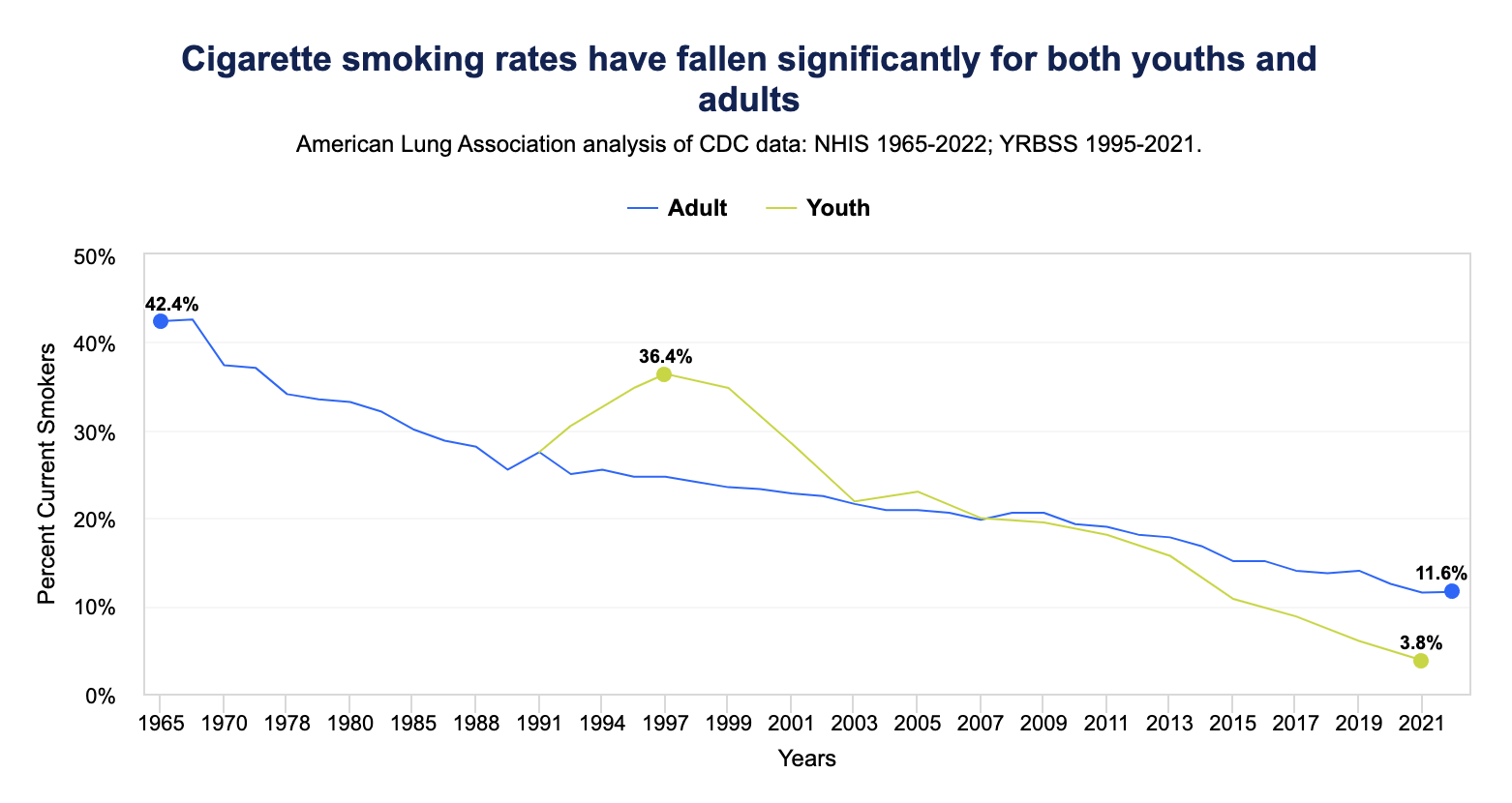
Image is a graph from the American Lung Association titled cigarette smoking rates have fallen significantly for both youths and adults, and it shows the years 1965 to 2022 with the graph going down over time for adults, but the youth smoking went up for a number of years in the 1990s and then went down.
The Cigarette Advertising Ban stopping radio & television advertising was passed in 1969 and went into effect in 1971. And cigarette smoking started to be banned in most or all workplaces (including restaurants and taverns) during the early aughts,. But it took until 2010 to ban manufacturing mild – the banning of companies from using terms like “light” cigarettes. And in 2019 the smoking age was raised to 21 nationally, and by then youth smoking was already down to 6%.
The two things that stand out as a focus for researchers and advocates has been the advertising of tobacco, which continues with indirect marketing, and that cigarettes were made more habit forming, and trying to stop that is still ongoing.
“Many people rationalize that if it were really dangerous the government wouldn’t let it be advertised. They are wrong in that thinking. It is dangerous and the government does let it be advertised.” — Rick Pollay, Pack of Lies: The Advertising of Tobacco (1992)
We’ve come a long way, but it’s taken decades pushing back against very big money from an industry, like so many others, seeming willing to wreck the public’s trust in science itself in order to keep extracting profits from the rest of us by hook or by crook.
Brandt AM. Inventing conflicts of interest: a history of tobacco industry tactics. Am J Public Health. 2012 Jan;102(1):63-71. doi: 10.2105/AJPH.2011.300292. Epub 2011 Nov 28. PMID: 22095331; PMCID: PMC3490543. “The industry campaign worked to create a scientific controversy through a program that depended on the creation of industry–academic conflicts of interest. This strategy of producing scientific uncertainty undercut public health efforts and regulatory interventions designed to reduce the harms of smoking. A number of industries have subsequently followed this approach to disrupting normative science. Claims of scientific uncertainty and lack of proof also lead to the assertion of individual responsibility for industrially produced health risks.”
This is so familiar.
Tech Policy Press - Beware of OpenAI's 'Grantwashing' on AI Harms - J. Nathan Matias, Avriel Epps / Dec 18, 2025 “We have seen this playbook before from other companies. In 2019, Meta announced a series of fifty thousand dollar grants to six scientists studying Instagram, safety, and well being. Even as the company touted its commitment to science on user well-being, Meta's leaders were pressuring internal researchers to "amend their research to limit Meta's potential liability," according to a recent ruling in the D.C. Superior Court. Whether or not OpenAI leaders intend to muddy the waters of science, grantwashing hinders technology safety as one of us recently argued in Science. It adds uncertainty and debate in areas where companies want to avoid liability and that uncertainty gives the appearance of science. These underfunded studies inevitably produce inconclusive results, forcing other researchers to do more work to clean up the resulting misconceptions. Grantwashing also benefits companies by undermining the credibility of scientists over the long term.”
Nobody’s saying that compulsive scrolling and posting on algorithm controlled social media is necessarily as bad as cigarette smoke to an individual. But it’s also really silly to try to equate doomscrolling as no different than listening to music just so you can twist yourself into pretzels to make some weird comparison to yesteryear’s bad policy for rock music. That said, listening to really loud music at rock concerts may harm your ears. And there’s no doubt that social media facilitated misinformation and scams have harmed society. About 20 years ago I heard someone, who’s now in jail, claim that video gaming and frequent napping were as bad as heroin addiction, which is totally bonkers. But video games have also been designed to be addictive, it’s true. So nothing is going to give you some simple story choice between oh it’s a nothingburger panic or oh my word this is the worst threat ever to everyone. That’s just not how reality works. Often, two things can be true at once.
This is such a similar problem I have seen for all these years around avoiding covid and public health activism, people taking precautions, or wanting mitigations, or people who are struggling with recklessness from others and a government that’s thrown in the towel on eliminating infectious disease spread, even in healthcare settings. Some people really want to believe it’s fine to get covid constantly, and some even insist that people ought to get it a lot and nobody should mitigate anything. Some people think that if you’re high risk, you should just accept your fate and put up with rolling the dice, getting sick and dying, because they’re eugenicists. And then there are those who reasonably want to protect themselves but who get drawn into weird online circles where people fanatically and problematically insist covid is doing things there is no good evidence for, apparently just to feel justified in taking precautions or supposedly to advocate. When the truth is more complicated than any of that, and you don’t need something to be the worst thing ever and 100% always catastrophic to want to avoid it. Yet some get tripped up this way.
I’ve known many smokers to live into their 80s, and nonsmokers who’ve died young, but that doesn’t mean it’s irrational to avoid cigarettes, or to wear an N95 mask to avoid breathing wildfire smoke or viruses. I know plenty of people who’ve gone to casinos and horse races and not lost their shirts, nevertheless most recognize that people seemingly trapped for hours at a time at the gas station convenience store, and emerging with nothing yet much lighter in the wallet, is a problem.
Two things can be true at once. In fact, many things can be true at once. And almost nothing is simple. So just like the worst person you know says something that makes sense once in a while, but a broken clock is wrong most of the day – the reality is that sometimes people want the right things for the wrong reasons, or want the wrong things for the right reasons.
When it comes to helping kids, I think of that saying nothing about us without us, and maybe people should ask the youths what they want. Oh, somebody did that in the UK, and as it happens, a lot of kids don’t want this crap that we GenXers and Millenials insist is oh-so cool.
A number of youths are not just objecting to social media, they’re actually objecting to the existence of the internet! My sense is that toxic elements of social media is what’s driving disdain for the entire information space that’s thrust upon them because they’re forced to use the internet for basic stuff, so find it hard to avoid the garbage.
The fact that many of us remember the internet before the most toxic of algorithms, leads some of us to keep hoping we can still recapture those old days early in our internet experience, which we no doubt gloss over anyway. I see this all the time with people trying so obviously to recapture the glory days of Twitter on Bluesky, which is a fool’s errand, and some people insist that Bluesky is a wonder of real genuineness despite the evidence to the contrary. And Twitter was never as good, nor as authentic, as anyone thought it was anyway. And I hate to tell you if you don’t already know this, but chasing the early special good feelings of a habit, is a very typical story for addiction, where at first there are benefits, there are good times, and only later the toxicity and dependence eventually becomes the only surviving aspects of the habit.
And in that Guardian article, someone said that the primary focus was to make sure that kids are using safer and less addictive websites.
Wait, so why wouldn’t we want that for everyone???